One of the most common questions I am asked is:
“My son/daughter has been given a dart board and is keen to start playing straightaway but could you tell us the height it should be from the ground and how far away the oche should be?”
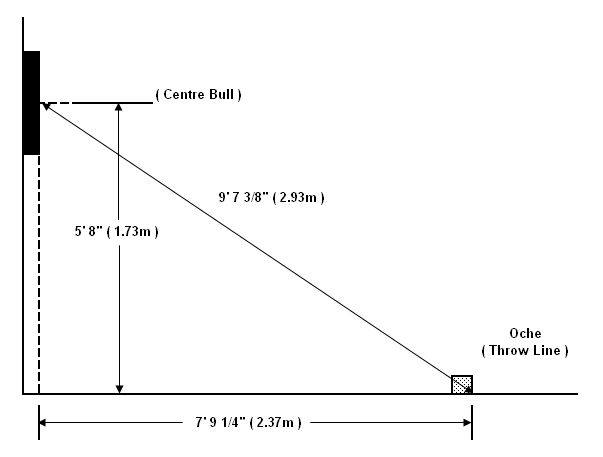
so it’s about time I put the answer on my website with the use of an excellent illustration, above, used with permission of David King (darts.501.com).
The height of the dartboard should be 5′ 8″ from the centre of bullseye in a plumb line to the floor.
The distance of the oche or throw line from the board should be exactly 7 feet 9¼ inches from the point where that plumb line reaches the floor.
These are the distances as prescribed in all major darts tournaments.
However, those of you who travel widely, especially in the UK, may come across different boards at different heights and a different throw line. In those cases ‘house rules’ always apply.
Choosing a location:
- The area should be away from high-traffic area to decrease the risk of injuries.
- Keep anything breakable away from the immediate area – darts fly off at peculiar angles.
- Try to erect the board where players are not distracted by people walking past
- The area should roughly be about 11feet long and 5 feet wide and should not have any obstacles in the way.
- The flooring should be considered also
– concrete floors tend to break shafts
– wood floors will look as though they have been attacked by woodworm after a while
– carpet will show the results of continuous walking - You will need to mark the throw line with either tape, a sticker, or a screwed down wood or metal bar.
- The purchase of a “dart mat” is the ideal situation. This is a roll out rubber mat that serves several functions. It protect the dart from breaking and dulling, it protects the floor and marks the proper distance to the throw line.
- There should be adequate room for spectators and players when they are not throwing.
- There needs to be a place for a score board in sight from the line, preferably right next to the board.
Hanging The Board: The board needs to be hung exactly 5 foot 8 inches from the floor to the centre of the Bullseye. Good quality boards are hung from the centre, making this measurement easy. If you have a board that hangs from the top, you will have to measure the distance from the centre of the bullseye to the hanger and add that to the height. If a back board is used to protect the wall around the board, this will also have to be centred around the board.
Marking The Throw Line: The throw line (also known as the oche) should be about 3 feet wide. It may be made of tape, a store bought throw-line sticker, a piece of wood or metal. It should be placed exactly 7 foot 9 and 1/4 inches from the FACE of the board.
Some British pubs use an 8 foot or 8 foot 6 inch measurement for steel tip darts. To measure from the face of the board, have someone hold a plumb line from the bottom-front of the board to the floor. If you don’t have a plumb line, you can use a piece of string with a pencil or dart tied to one end. Make sure the throw line is exactly perpendicular to the face of the board and centred with the board. This can be accomplished by measuring from the bullseye to each corner of the line.
Lighting: Proper lighting of the dart board is very critical. It is important to be able to tell exactly where the dart landed without moving from the throw-line. The ideal lighting is from 2 lamps mounted from the ceiling to the left and right of the board.
(c) 2012-26 Patrick Chaplin and David King.
 Dr Patrick Chaplin