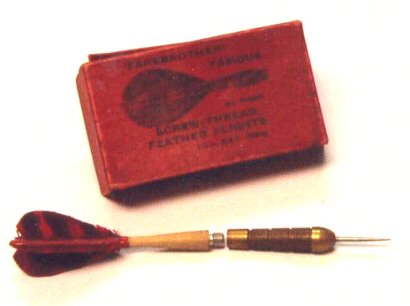
Back in 2003 a visitor to my website asked me if I knew anything about a darts manufacturing company called Farebrother.
The enquirer knew little about the company except for what was written on the box of the set of darts he had purchased. The sum total of my knowledge of the company at that time was about the same. I promised to try and find out more.
In early 2004 I placed a letter in Darts World asking for information. Two readers responded one recalling that Farebrother Darts were sold ‘years ago’ at a sports shop called ‘Up and Running’ in High Wycombe, the other telling me that Farebrothers was based in a ‘tatty building’ in Hornsey Road, Holloway, London. According to this latter source ‘Farebrother and his wife ran the business’ although my source seemed to think that ‘Farebrother himself was only in it for the interest and to keep out of his wife’s way’!
In the summer of 2004 a darts fan named David O’Brien contacted me stating that he had read my plea on my website and that he had recently purchased a set of Farebrother darts. The box carried the address ‘H. B. Farebrother Limited, London’ but, more interestingly it also bore a patent number. Further research by Dave revealed that the patent was applied for under the names of Albert Stanley Kirk of Holloway, London and Henry Balcombe Farebrother of Palmers Green in 1952 and that the patent was granted in 1954.
In June 2004 there was a further breakthrough. Through a contact in the darts business I was put in touch with Sidney Payne, a nephew of Henry (known as ‘Harry’) B. Farebrother, and he revealed the history of the company from his perspective.
Harry set up the Farebrother company when he came out of the army after the Great War. Harry and was based in Finsbury Park, London making tennis rackets. (Harry was an enthusiastic tennis player.) From there he went on to import cricket bats and balls from India and the company thrived. Indoor games, including darts, came later, circa late 1940s/early 1950s. By then the company was based in Holloway, north London.
Farebrother Limited was never into direct sales concentrating on trade only. It never had a shop. The company was based in Hornsey Road, Holloway, N.19 and consisted of a Ground Floor (where the machinery was accommodated), whilst on the first and second floors three or four ladies assembled the darts and packed them. The stock room was also on the second floor.
Sid told me that in the early 1940s, when brass was in short supply, Harry used to go to Unicorn Products Ltd., at Upper Norwood, south-east London to source his material. At that time the Unicorn engineering side was machining items for the government and had an allocation of brass rods. Harry purchased some of these rods from Unicorn so that he could make his own darts. He apparently helped to pin (put the points in) the dart barrels and then bought the barrels off of Lowy at 6d a gross.
Harry then purchased plastic for the flights and the cardboard boxes which at first did not bear the Farebrother name. During the late 1950s/early 1960s Farebrother’s made feather flights. Workers were trained to stick the left-hand wing on the stem whilst others were trained to put the right-hand wing on the stem. Neither was allowed to do the others job. At one stage there was a shortage of English turkey feathers so they were imported from the USA.
In early 1950s Farebrothers started making their own dartboards. They utilised poplar wood (they used to buy ¾ inch, 1 inch and 1½ inch sections) and also paper from Scotts of Basildon, Essex (manufacturers of the Scott “Keep Drye” dartboard).
Sid joined the company in the late 1950s as a commercial traveller and covered England from Cornwall up to the Humber and Lincolnshire. By this time the selling was easy as darts as a game was very popular and so darts were sold by most sports shops.Sid recalls working one week ‘on the road’ and then one week dealing with orders. The companyexported darts to many countries including Australia, New Zealand and Singapore.
According to Sid Payne, Farebrother was one of the first companies to manufacture tungsten darts. It was an expensive process Sid recalling that sometimes the tools used in the manufacturing process ‘wouldn’t stand up to the tungsten’. This was in the mid-to-late 1960s but, Sid said “There was no demand at all.” The shopkeepers sold a set of Farebrother tungstens at £3 per set which was a large amount of money is those days. Sid told me, “They’d have one set. The next time they’d say, “I’ll have three sets.” Hardly big orders!
Harry left Farebrother Limited in early 1970s by which time Sid was Director of the company. Sid worked there until 1992 when he retired at the age of 65 and the business (or rather the stock) was sold to Bullseye Ltd., of Watford circa 1995/6.
Patrick Chaplin
© 2009 Patrick Chaplin
Photo: David O’Brien
With special thanks to Sid Payne and Andy and Marion Andrews
 Dr Patrick Chaplin
Very interesting information on H.B.Farebrother, especially the “..export to…Singapore..” as, I suspect, that’s where my late Father purchased his set of ‘Concentric darts’ when on National Service.
I still have them & the original , if somewhat battered, orange box, which is longer than the box used as an illustration. I don’t recall any flights being with them but they did have a set of very worn & frayed bamboo, I think, stems which I remember would not hold flights in place when thrown!
Without stems or flights, they weigh 28.51g, 28.56g, & 29.00g, with fixed steel points.
Regards,
Clive
LikeLike
Hi,
Got the Farebrother darts out last evening to re-stem & flight them, only to find that the ‘thread size is about twice that of ‘modern’ darts!
When did they change, & can they still be purchase?
Regards,
Clive
LikeLike
My uncle gave me a set of tungsten Fairbrother darts, the points were ground down, and they were very dirty, I have polished them up, put in new target stems, and new steel points and they are great to play with. They are a little light for me at 21g. But they fly true.
LikeLike
I have a set of farebrother medium darts with green feathers and wooden stems. I am assuming they were made before the company started using plastic.
LikeLike
My father (born pre 1900) was a lifelong DARTS PLAYER also a Member of The News of The World – TREBLE TWENTY GUILD ( to which acknowledgement he always wore a BADGE depicting 3 darts in a treble 20 Board Slot ) I was born 1937, 2 doors from The Kings Arms PUB in Chesham My father frequently “RAN” the Pub when Wally and Bertha were “tired”. He was both a popular “Landlord” Pianist and Darts Player keeping the KA ‘popular’ throughout the WAR Years, especially with locally Stationed US Airforce personnel, also Scots Tank Regiment personnel, located in local Woodland, preparing for The D-Day Invasion, neither WE or THEY knew anything about at the time. After The War my father worked for a large Manufacturing Company which had Staff Recreation, including a serious DARTS TEAM. He was a Team member when they WON (several times) the LOCAL TOWN’S DARTS LEAGUE.
See Attached images of my father’s “FAIRBROTHER” Darts, still in their perfectly preserved “orange” Box, as he Played with them, before passing them to me for use in the local Boys Club.
SORRY – no means for Attaching images.
Brian D Dunn.
LikeLike
Hi Brian, Thanks for your very interesting email about your father, the pub and his Farebrother Darts. Sorry that you could not send the images you mentioned. Please send them to me at patrick.chaplin@btinternet.com as I would like to see them. Best wishes, Patrick
LikeLike
Did fairbrothers ever make a wooden barrelled dart Thanks David
LikeLike
Hi David. As far as I know, Farebrothers only produced darts with brass barrels.
LikeLike
thank you for your reply that’s what I thought someone is selling a set of wooden darts with lead weights in a fairbrother box
LikeLike
I also have a set all wood stem and barrel with lead built in for the weight in a farebrothers box
LikeLike