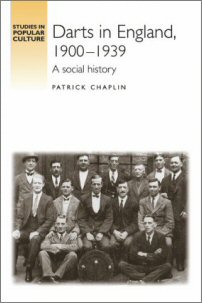
darts in England 1900 - 1939


As regular visitors to my
website will know, I completed my PhD in December 2006 and was always hopeful
that my work would see the light of day as a book.
So, it is with the
greatest of pleasure that I confirm that the book based on my PhD research is to
be published by Manchester University Press (MUP) in Spring 2009. The book,
entitled Darts in
England 1900-1939 – a social history
(ISBN 978-0-7190-7803-3) will be published as part of the prestigious MUP series
‘Studies in Popular Culture’.
As is common with
academic publishing, Darts in England the first edition will be produced
in hardback and the price of the book will be in the region of (Wait for it!)
around £55! I know that sounds very high but this is entirely due to the
fact that academic books tend to have only short print runs (about 400-500
copies) to begin with and are targeted, in the main, at individual scholars,
universities or other academic institutions.
I believe that my book
will be of interest to all darts fans especially those who want to learn more
about the history of our great sport and hope that some of you will be able to
invest in this unique work. Being a short print run I am hopeful that the
hardback first edition will sell out quickly.
If initial sales are good
and there is a demand from the darts community for the book I am hoping that the
MUP will consider publishing a paperback version at a later date which would
retail for a lot less. (Fans wishing to press the publisher for a paperback
version can help by e-mailing the Manchester University Press via
www.manchesteruniversitypress.co.uk.)
For those wishing to purchase my book this
can be done via the attached PDF form.

Darts fans should also
note that, in addition to Darts in England,I have three other
darts-related books being published in 2009.
Watch this website for
details!
To read a sample chapter, please
Click here
All the best,
Patrick Chaplin

Dr Patrick Chaplin - 'Darts in England 1900-1939'

12 Years in
the making, Dr Patrick Chaplin reveals the social history of Darts in England
1900 -1939.
Self funded,
Patrick Chaplin researched the true social history of the sport of darts from
its early origins through to the inter war years. The book is a slight revision
of Patrick’s academic work used to gain his PhD in 2006. Patrick was later
awarded the title of ‘Research Fellow in History’ at Anglia
Ruskin University (ARU), Cambridge.
I have
waited a long time to read this book as it truly enlightens how some of the
perceived and embellished ‘truths’ came to light.
The book
covers in detail how the early origins dart and dartboards were manufactured in
some cases on an individual local level. Early boards were made from a number of
materials including wood and clay! prior the concept and introduction of the
sisal, bristle board by the Nodor Company in the 1930’s. Boards also and had
local variation and different numbering systems of which some still survive
today. Patrick explores the social side of the sport and how the sport developed
via the working and upper classes of England.
Ever
wondered who is credited with the modern numbering system on the dartboard or
who was behind the expansion of the sport in the early years? This book tells it
all from the emergence of a few entrepreneurs that made the sport accessible to
the masses, to the introduction of dart leagues such as the ‘National Darts
Association’, the breweries, national newspapers and individuals that took the
sport to a new level. The book not only covers the importance of darts as a
social sport during these years but how and why it helped to change social
attitudes. Darts was not just a working class game played in pubs but also
emerged as an upper class activity.
During the
research Patrick reveals a number of key times that changed the way we see darts
today, including the introduction of darts to public houses; how it became the
dominant pub game; the acceptance of the ‘Clock’ dartboard as the standard
national board; the involvement of the national newspapers reporting and first
regional and national competitions.
Patrick
relives the court case that nearly banned darts from the public house as betting
on games of luck was banned in pubs. It took a demonstration at a local court to
prove darts was a game of skill and the case was dismissed. Despite this the
city of Liverpool refused to allow the game to be played in public houses during
the 1930’s. This was not down to betting but down to the perceived issue that it
encouraged a person to drink more, which was an issue with the local authority
at the time. Patrick refers to research conducted at the time demonstrating that
in fact it didn’t encourage people to drink more, if anything, less. But one thing
darts did do for the public house was to encourage more people to their venues.
The sport of
darts clearly made a significant difference during the social leisure time of
the early twentieth century and it is clear from this academic work why it took
so long to research. The book is written in an academic format, thus containing
all references, research material, conclusion and bibliography. This said if you
ever wanted to know about the true history of the sport then this book is a
must.
The hardback
book has a limited print run of 450 copies and although it has a price of £55,
it is a must for all dart fans. This book will also appeal to sports historians
and social history scholars
Due to this
limited print run I suggest you order your copy now otherwise you may be
disappointed. However Patrick is hoping the book may be published in paperback
next year
“In my opinion it is the most
important book written about the sport of darts and is probably the best book
you will ever purchase about this wonderful sport.”
David King
Darts501.com
A sample chapter and the book is available via direct order from the
Manchester University press
Click here.
Waterston’s online shop Click here.
Amazon online shop Click here.
June 2009

Dr Patrick Chaplin - 'Darts in England 1900-1939'
Manchester University Press
This is the first ever
academic work about the sport of Darts and its origins and it was substantively
written as part of Chaplin's studies while acquiring his PHD.
The fact that Manchester
University Press have deemed the study worthy of publication indicates its
importance, not just to recording properly the history and origins of Darts, but
just as substantively its impact in British society at the time.
Extensively researched,
Chaplin's source reference list is amazing. The list of reference notes and the
bibliography are huge. It seemed the author left no stone unturned in trying to
present a balanced and factual view of the history of Darts and this is the
product of many, many years of hard work.
Chaplin examines the origin of
Darts and debunks many popular myths thrown about by Darts commentators and
journalists. The Henry VIII story is hogwash for example and Chaplin gives us
the most believable account of the famous 'Anakin' case to date.
Although Darts is absolutely
an English game, 'darts' themselves definitely have their origins in France! It
took some years for English companies to seize the initiative and begin
manufacturing brass darts for mass pub play.
Chaplin chronicles the rise of
the early dart and dartboard manufacturers in England and he brings to life the
huge darts boom of the 1930s - when darts was socially acceptable across all
classes.
It's not all about Darts
though. The author discusses the public house and its development in the early
part of the last century as well as examining the gradual introduction of other
forms of leisure entertainment as workers found they had time to enjoy life,
thanks to reduced working weeks.
There are nods to the present
day and the author explains well how these early days of Darts sowed the seeds
for the multi million pound sport of today.
This really is fascinating,
interesting and important historical tome.
The purchase price will be off
putting for many at £55, but the book has a very limited print run. I would
guess coercing a public library into sourcing a copy would be the best bet for
most.
A huge achievement from
Chaplin and one can only hope that a follow up is planned filling in the
1945-1970 years when before Darts became a televised phenomenon.
Andy Fairclough
Superstars of Darts
July 2009

Darts In England 1900-1939 : A Social History
by Patrick Chaplin

Charis Mutschler of the
prestigious German darts website
www.darts1.de has reviewed my book Darts in England 1900-1939: A social
history. Here is the review as featured on the website, followed by Charis’s
English translation.
Patrick Chaplin: Darts in
England 1900 – 1939: A social history
Patrick Chaplin
– der einzige Dr. Darts – hat dieses Buch auf der Grundlage seiner Doktorarbeit
erarbeitet. Akribisch und sorgfältig hat er Quellen ausfindig gemacht und
ausgewertet, um die Verflechtung zwischen der sozialen Entwicklung in England
und dem aufstrebenden Dartsport darzustellen.
Was dabei
herausgekommen ist, ist ein wirklich interessantes und gut zu lesendes Buch in
verständlichem Englisch, wenn auch nicht unbedingt für Jedermann, was auch schon
der recht hohe Preis verhindern wird-
Chaplin stellt
zunächst einmal richtig, dass Darts ursprünglich nicht aus Großbritannien kam
sondern sich aus dem französischen „Flechette“ entwickelt hat.
Auch rückt er
die Beziehung Darts und Pub etwas zurecht – es war beileibe nicht so, dass Darts
von Anfang an und überall im Pub gespielt würde. Es war viel mehr so, dass die
großen Brauereien Dart und Dartligen in den Pubs massiv unterstützen – einmal um
die Leute vom vielen Trinken und vom Glückspiel abzuhalten und die Pubs durch
das Angebot von Pub – Games aus düsteren Kaschemmen in wirkliche Public Houses
umzuwandeln und zum anderen um die Leute – und zwar nicht nur die Männer – bei
der Stange zuhalten, in einer Zeit in der Kino und Music-Halls immer größeren
Raum in der Freizeitgestaltung der Menschen (die auch mehr Freizeit hatten)
einnahmen, vor allem auch, weil man mit Frau oder Familie dort hingehen konnte.
So blieb den Brauerein und Pubbesitzern nichts anderen übrig, als die Pubs
attraktiver und zumindest Frauenfreundlicher zu machen, damit sie überhaupt
konkurrenzfähig blieben.
Mit der
Gründung der National Darts Association erhielt der Sport dann allgemein gültige
Regeln und Vorgaben und auch die Massenmedien, vor allem die Sonntagszeitungen
(News of the World) unterstützen den Sport durch Berichterstattung und indem sie
große Turniere sponserten.
Ein sehr
empfehlenswertes Buch für alle die an Sozialgeschichte, Geschichte der
Freizeitkultur, Soziologie oder einfach nur am Dartsport interessiert sind.
Zu beziehen ist
das Buch über die Manchester University Press, es kostet 55 brit.Pfund.
Charis
Mutschler, November
2009,
www.darts1.de
Patrick
Chaplin Darts in England 1900 – 39 A social history English
translation
Patrick Chaplin – the only
existing Dr. Darts – wrote this book on the basis of his PhD thesis.
Meticulously and carefully he sought out sources and analysed them to be able to
show the interconnections between the social development in England and the
rising sport of darts.
The result is a really
interesting and good to read book, might be not a book for everyone something
the high price will hinder anyway.
Chaplin first corrects the idea
darts has it origin in Great Britain – originally it was a French game called
“Flechette” which was developed in Great Britain into darts.
Then he sets right the
relationship between the sport and the pub – it was not that darts was played
from the beginning and everywhere in the pub. It was the big breweries which
supported and established darts and dart leagues in the pubs. One of the reasons
was to hinder people from massive drinking and from all kind of gambling – darts
was a proven game of skill. Another reason was that it got necessary to change
the pubs from low pubs into real public houses to get more people into the pubs
offering pub games to pass there the leisure time (and more leisure time people
had) instead visiting the new attractions like the cinema and the music halls
were you could even take your wife of girl friend or the whole family as well.
So the pubs had to get more respectable and family friendly and darts helped to
this.
When the National Darts
Association was founded the sport got generally valid rules. The mass media
supported the growing sport as well –especially the Sunday papers (News of the
World) gave the sport a lot of coverage and helped to sponsor tournaments.
A highly recommended, unique
book for people interested in social history, leisure time culture, sociology or
in the sport of darts.
You can buy the book from
Manchester University Press, the price is 55 brit.pounds
Charis
Mutschler. November
2009.
www.darts1.de
Author’s reply:
I am thrilled that Charis
Mutschler has reviewed my book and am equally pleased that she has
enjoyed it. I think this is the first time that my book has been reviewed
outside of the UK. As Charis says it is a very expensive book but unfortunately
for the general reader that is always the case with academic publications.
However, I do hope that
Manchester University Press will bring out a soft cover version of Darts in
England in the near future which will retail at a more reasonable price. I
hope this will then encourage more darts fans to read what I have discovered
about the history and development of the great sport of darts.
Thanks to Charis for her very
positive review.
Patrick Chaplin
November 2009
© 2009 Patrick Chaplin |