In June 2004 I received the following e-mail from a visitor to my web site.
“Hello Mr. Chaplin,
Could you please tell me why we only use 3 darts in one turn? I have a friend that is about to go insane trying to figure it out. Can you please HELP me???????? Thank you soooo very much.”
To be honest I hadn’t given the matter much thought up until then. In addition I didn’t want anyone going insane just because I hadn’t an immediate answer .However, upon reflection, the answer seems quite straightforward.

Darts has been played in inns and taverns, in some form or another for at least 500 years. Darts were thrown or blown mainly for fun and entertainment or gambling and to begin with there was no rigid rules to say how many darts should constitute a ‘throw.’ When darts is mentioned – and it rarely is – in old manuscripts and legal documents, it is difficult to interpret whether the game of ‘darts’ referred to, say in a court case, was the type blown through a tube or those that were thrown at a target. The nature of the games varied for about 400 of those 500 years.
In the mid-1920s the game of darts was standardised for the first time and the rule introduced that ‘each throw shall constitute three darts.’ These rules were used in the News of the World Championship from the very beginning (the 1927/28 season) and, as darts became incredibly popular in pubs throughout England in the late 1920s and 1930s, were universally adopted by all dart players across Britain and, indeed eventually, the rest of the world.
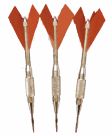
The original darts, used in the game as we know it today, were manufactured in France (see photo above) and imported by various companies from the late Victorian period onwards. They were sold wholesale to sports retailers in boxes of a gross (144). Dart players – who were mainly working class – could buy darts in whatever quantity they wanted. So you would start out by buying a set of three and then, as one dart broke or was lost, that single dart could be replaced. Remember the working class did not have money to burn. In some cases the landlords of pubs would buy darts in bulk and leave sets on the bar for customers to use, thus saving the customer the bother of having to find the money to buy a set. The landlord was happy to provide the darts for nothing because, as long as the players were playing, they would also be drinking.
Darts were not sold in boxed sets of three until 1938 when the founder of Unicorn Products Ltd., Frank Lowy, marketed the ‘Silver Comet’ all-metal dart, which came in a sturdy flip-top box and sold for 2/6 (two shillings and sixpence) – about 13p today. However, 2/6 was a hell of a lot of money in those days.
Just as the original forms of football and cricket were bastardised for the sake of uniformity and control, darts also was standardised and the resultant rules blew away any earlier versions.
[Fortunately, my response arrived in time to prevent my correspondent’s friend from picking a window.]
© 2004, 2007 & 2019
 Dr Patrick Chaplin